HomeServicesConsultation and assessment
Neurosurgery in Mexico City
Consultation and assessment
A consultation is the point at which a symptom or test result becomes a plan: monitoring, ordering another imaging study, trying nonsurgical management, or discussing an operation. Care is provided for brain, spine, and nerve conditions in Mexico City. This is not emergency care, nor a promise that every case will end in surgery.
What the first visit is for
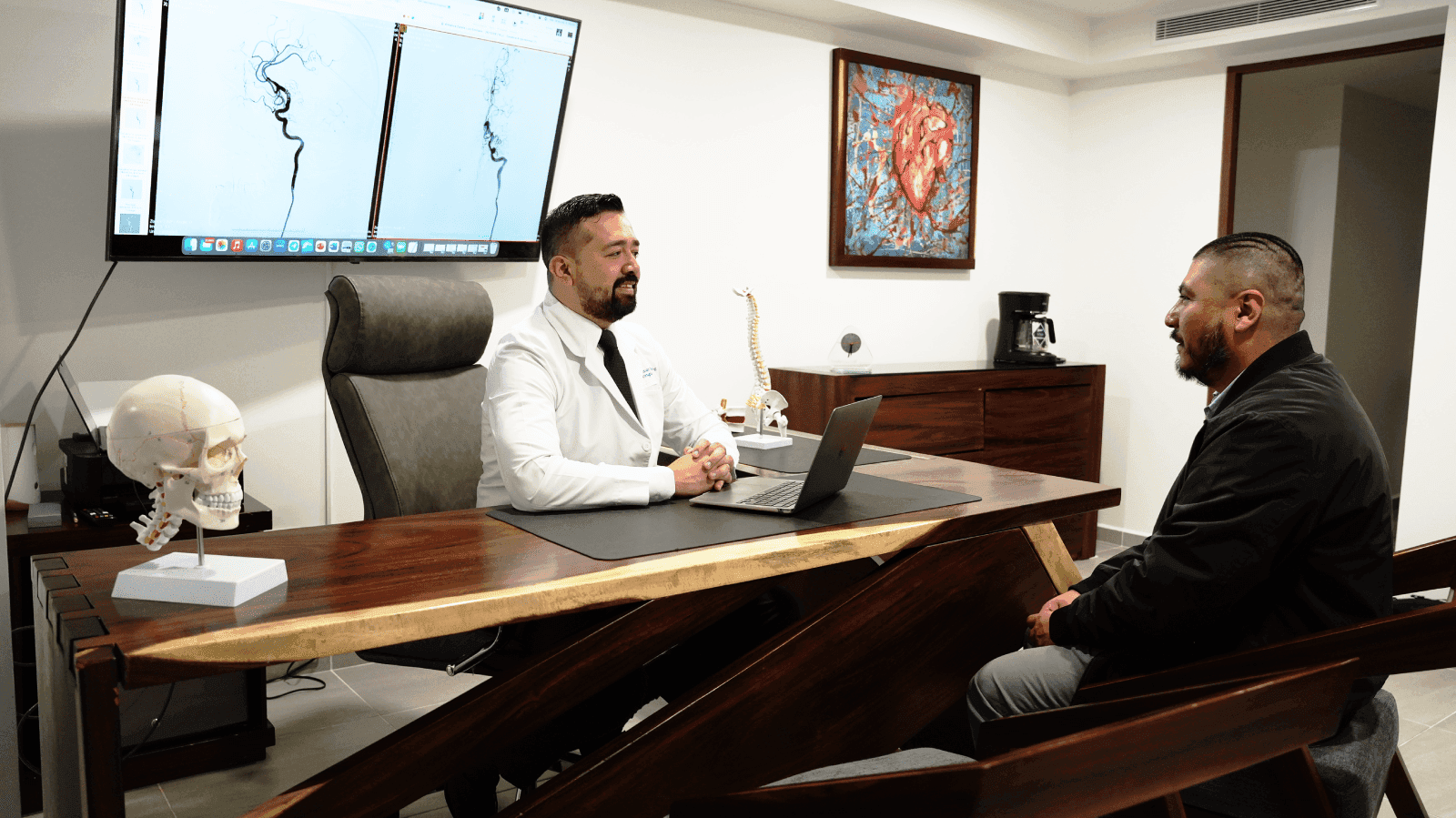
We review when the problem began, what makes it worse, and which treatments have already been tried. The neurological exam checks strength, sensation, reflexes, gait, cranial nerves, and signs of spinal cord compression. Based on this, we determine whether the tests you bring are sufficient or whether an MRI, angiogram, or specialist consultation is needed. The result of the appointment is a reasoned recommendation, not a generic form.
Reasons to schedule an appointment
It is often helpful to schedule an appointment when there is already a finding or symptom that another doctor has not resolved:
• An aneurysm, malformation, or cavernoma described in a report.
• Neck or lower back pain with tingling, weakness, or claudication while walking.
• A newly reported brain or spinal cord lesion—tumor, cyst, or hydrocephalus.
• Shock-like facial pain that did not improve with initial treatment.
• A second opinion before agreeing to surgery proposed at another center.
• Monitoring a condition that was previously decided to observe, using earlier imaging for comparison.
How to arrive with imaging that can be reviewed
Bring the written report and the images, not just the one-line conclusion. Make a note of your medications, allergies, surgeries, and whether you take anticoagulants or antiplatelet medications. If you have spinal pain, it helps to know what rehabilitation you had and for how long. During the visit, we will review whether the imaging finding corresponds to your symptoms: a small herniation does not always explain a weak leg, and an incidental finding does not mean surgery is necessary.
What this appointment does not replace
A sudden-onset deficit—affecting speech, strength, or vision, or the worst headache—needs emergency care, not an appointment scheduled for the following week. The consultation also does not involve adjusting doses or renewing prescriptions from another provider without reviewing the case. If the reasonable course is rehabilitation, pain management, or clinical neurology, that is stated clearly rather than pushing for a surgical recommendation.
Before booking
Do you need surgery to be seen? No. Many assessments result in monitoring or nonsurgical treatment. Coming in does not commit you to a procedure.
What if I don’t have any imaging? An exam can be done, and we can decide what imaging to request. If you already have imaging, repeating it without reviewing it first often delays the decision.
Does a second opinion contradict my doctor? Sometimes it confirms the plan, and sometimes it suggests another approach. The basis for the difference is explained: size, symptoms, how long the condition has been present, or the risk of the procedure.
Book an assessment
To book, write to +52 55 2193 8191 and include the date of your imaging. If there is no reply because a surgery is in progress, Karina can coordinate at 55 4822 5130; the line 55 3763 6630 is also listed. Office hours are Monday 15:00–20:00 and Wednesday 10:00–14:00, at Hospital MAC La Viga or Hospital Ángeles Lindavista. The email is martin.casas.ncx@gmail.com. Do not describe symptoms in the public form.
Reviewed by Dr. Martin Roberto Casas Martínez · Last reviewed 23/09/2026 · Professional license 10033165